
Agentic Knowledge Work Impact on Jobs & Costco Brisket Breakdown
Everyone is wondering how AI is going to impact jobs

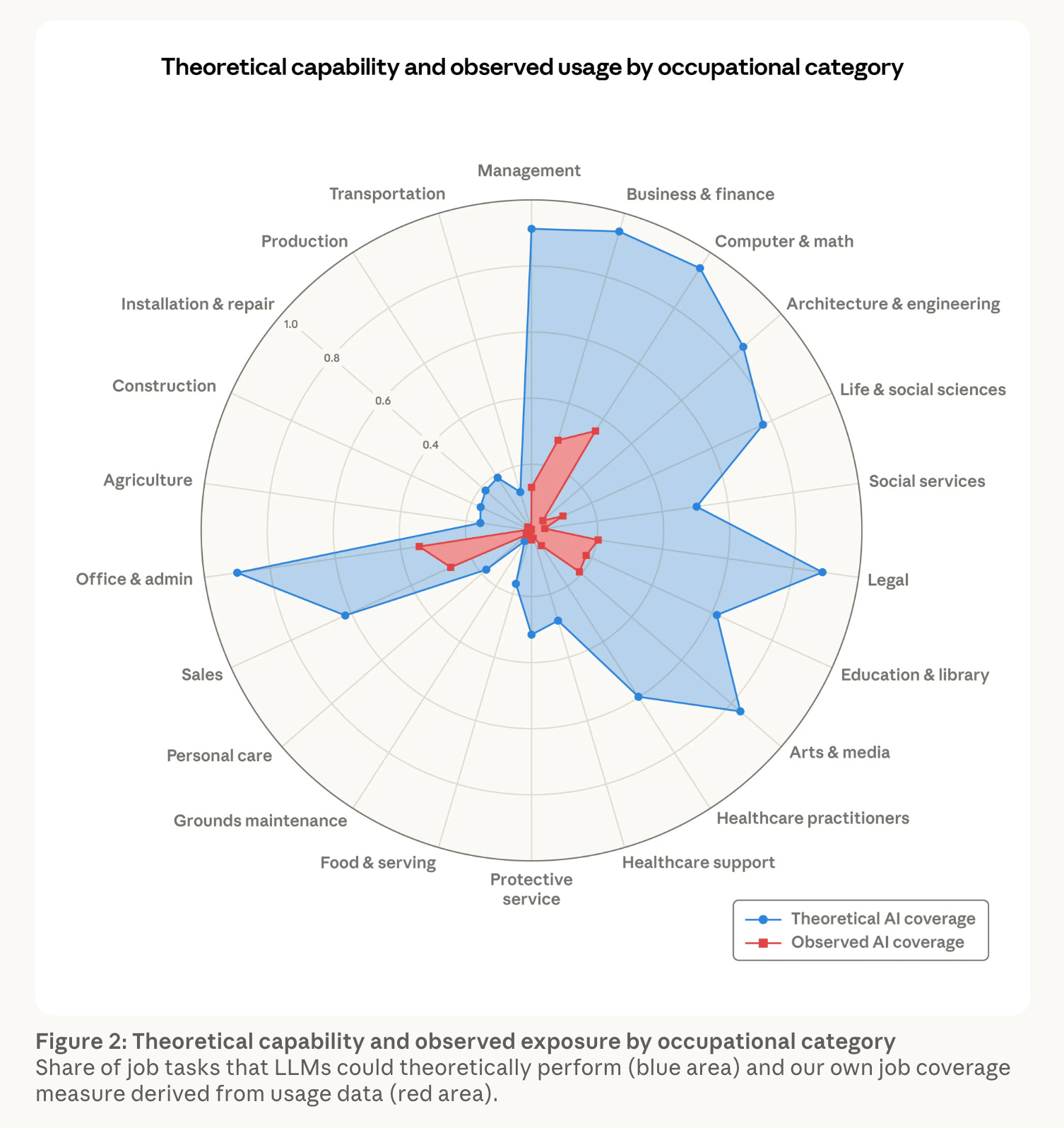
Everyone is wondering how AI is going to impact jobs. Anthropic had a piece called the Labor market impacts of AI a couple of weeks ago. The piece had a very interesting chart comparing the theoretical capability and observed usage by occupational category. You can see in occupations with high theoretical capability, the usage has seen higher growth:
The WSJ had an article called What Young Workers Are Doing to AI-Proof Themselves.. Some college students are pivoting from careers in software engineering to fire-fighting or going to trade schools. I know someone personally who had graduated a number of years ago but is going back to trade school to be an electrician.
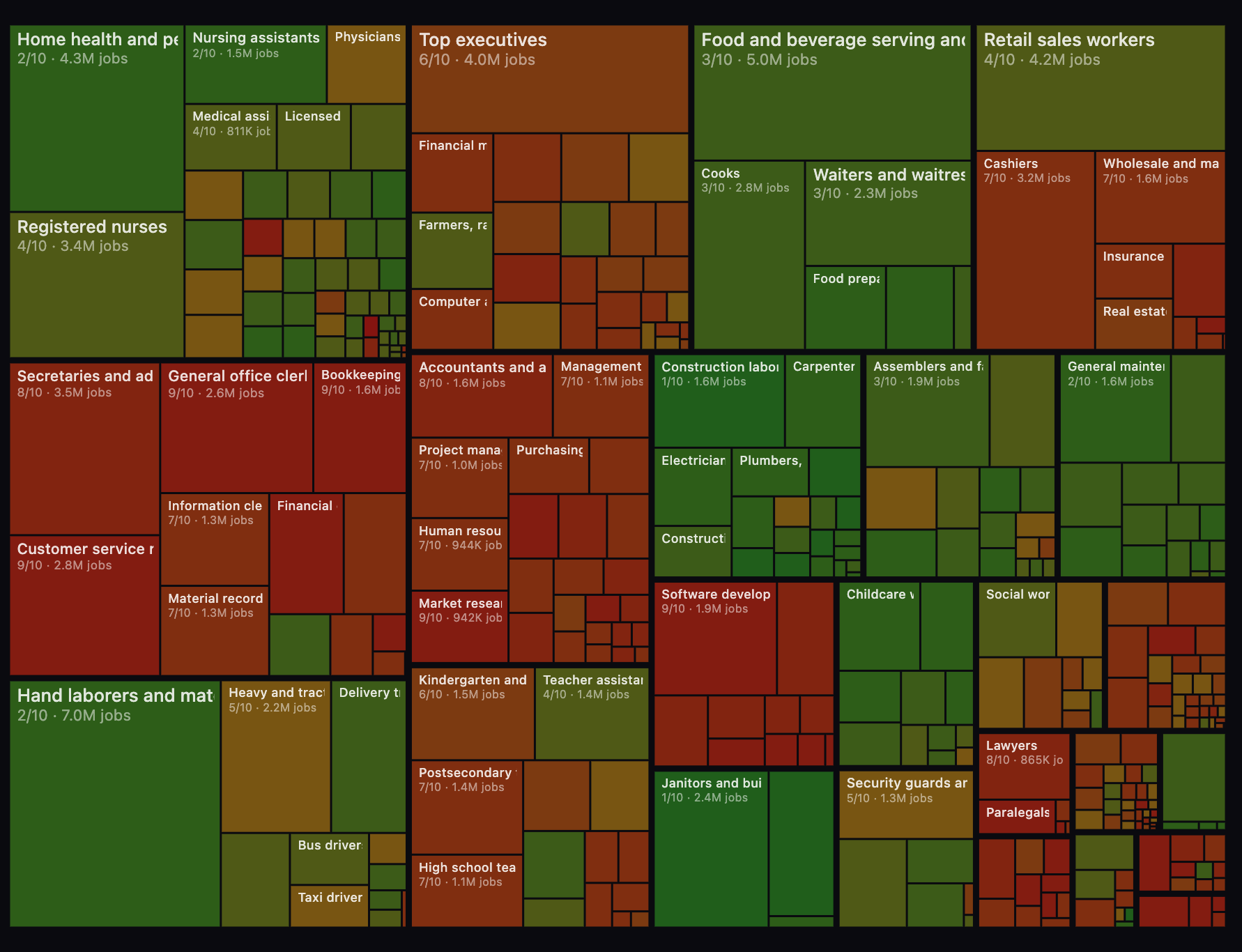
Andrej Karpathy created a project visualizing the US Job Market. He used an LLM to quantify “Digital AI Exposure”. Below the red is highly exposed jobs according to this metric. Although there is a caveat that just because a job is highly exposed doesn’t mean it will disappear. He uses software engineering as an example, “Software developers score 9/10 because AI is transforming their work — but demand for software could easily grow as each developer becomes more productive.”
In my own work, I estimate I am doing 3.5 jobs now at UKG. My official title is Data Science Manager where I manage 4 other data scientist’s work. But I’m still doing IC-level Machine Learning work from my past though at even higher level now. I’m also moonlighting as a data engineer, Python tool builder/maintainer, a skills marketplace maintainer and AI Teacher. All of this has been made possible by Agentic AI, specifically Claude Code.
Karpathy had a tweet I wholeheartedly agree with:
With improving capability, every point in time has an optimal setup that keeps changing and evolving and the community average tracks the point. None -> Tab -> Agent -> Parallel agents -> Agent Teams (?) -> ??? If you’re too conservative, you’re leaving leverage on the table. If you’re too aggressive, you’re net creating more chaos than doing useful work. The art of the process is spending 80% of the time getting work done in the setup you’re comfortable with and that actually works, and 20% exploration of what might be the next step up even if it doesn’t work yet.
I do try to ask myself very frequently: “What is the agent-first way of doing this?” I’ve had to rebuild so many different habits I’ve built up over 15 years of working.
I’ve been telling my friends and those close me that I think knowledge work is changing fast. So much digital work or work that can be done on a computer is going to be done by AI Agents or more specifically those people who have developed expertise in using AI Agents. And in 1-2 years, if you are not keeping learning how to use AI, specifically agentic AI, you will not be employable in these white-collar jobs where you’re primarily using a computer. It takes time to develop skills in working with AI in your field. I encourage everyone to start now. Invest 10-20% of your time trying to reproduce your current work or workflows using AI.
Things I’ve Written or Created
I’ve enjoyed learning about agent skills over the past few months. There are so many great skills marketplaces and plugins out there. I wrote about how it’s now possible to easily setup a skills marketplace for your own organization. That way your employees have a central place to contribute new skills and install and use existing skills. I’ve tried to make this easier by creating a skills marketplace template here: https://github.com/lawwu/skills-marketplace. It is a Cookiecutter Template for an Agent Skills Marketplace. I tried to consolidate some of the best practices I’ve seen across skills marketplaces.
I started a personal open-source skills repository where one of the skills is to create a Claude Code skills marketplace using the above template. You can find that skill here.
I’m finding a lot of value in not only single skills but chaining together many skills in succession. As a data scientist who trains machine learning model, I’ve tried to create some skills to do machine learning end-to-end with a chain of skills. You can find that project here: agentic-ml-plugin.
Inspired by Simon Willions’s prolific blog, I also added links (original source) and quotes to my blog.
Claude Code Related Items
Anthropic has a bunch of free courses now on skilljar: the ones that look good to me are on Claude Code, Intro to Claude Cowork, and Agent Skills.
Claude Code System Prompts - a repo with not just the system prompts of Claude but the tools too
Anthropic is having their second Claude Dev Conference on 5/6.
Thariq wrote an article on Agent Skills that is good
Thariq also hosted a livestream of skills that I streamed with some of my co-workers at UKG. Here are my notes from the first half. The idea of a golden marketplace and automated skills evaluation was very inspiring.
The Claude Code CLI is changing so fast. They added
/btwrecently. You can use it to ask side questions during an active session. More details here. I love how they defined it as “/btwis the inverse of a subagent: it sees your full conversation but has no tools, while a subagent has full tools but starts with an empty context. Use/btwto ask about what Claude already knows from this session; use a subagent to go find out something new.”Channels - Claude Code now has an OpenClaw like feature where you can send messages from chat apps like Telegram.
I missed this skills marketplace but there’s one that is specific to financial services: https://github.com/anthropics/financial-services-plugins
Other good listens/reads
I enjoyed this interview of Andrej Karpathy:
A great quote:
To get the most out of the tools that have become available now, you have to remove yourself as the bottleneck. You can’t be there to prompt the next thing. You take yourself outside. You have to arrange things such that they’re completely autonomous. And the more, you know, how can you maximize your token throughput and not be in the loop? This is the goal. And so I kind of mentioned that the name of the game now is to increase your leverage. I put in just very few tokens just once in a while, and a huge amount of stuff happens on my behalf. And so, auto-research, like I tweeted that, and I think people liked it and whatnot, but it doesn’t. They haven’t maybe worked through the implications of that. And for me, auto research is an example of an implication of that. Where it’s like, I don’t want to be the researcher in the loop, looking at results, et cetera. I’m holding the system back. So the question is, how do I refactor all the abstractions so that I’m not I have to arrange it once and hit go. The name of the game is how can you get more agents running for longer periods of time without your involvement, doing stuff on your behalf. And autoresearch is just, yeah, here’s an objective, here’s a metric, here’s your boundaries of what you can and cannot do, and go.
Latent Space podcast with Fleix Rieseberg, PM of Claude Cowork was a good listen - I learned Claude Cowork is just another agentic harness around Claude Code with prompts optimized for non-coding tasks. This inspired me to try to use it more non-developer tasks
On that note I used Claude Cowork to create this video I’ve been wanting to make for awhile. My post has some screenshots on the Claude Cowork workflow. This is the final product (in case you want to learn how to slice some brisket and save some $)